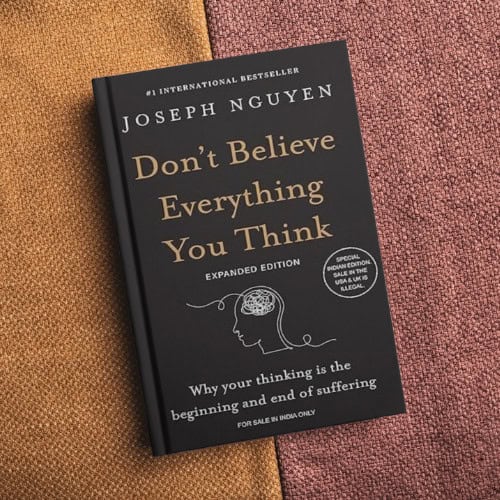
Don't Believe Everything You Think — Joseph Nguyen

Your brain is remarkably efficient — and remarkably unreliable. Joseph Nguyen’s Don’t Believe Everything You Think argues that most of our suffering comes not from the world as it is, but from our thoughts about the world. And those thoughts are riddled with biases, shortcuts, and distortions that we rarely notice.
About the Author
Joseph Nguyen is a respected author and expert in cognitive psychology who helps readers recognise and challenge their biases. His expertise in cognitive distortions shines through in offering practical strategies to overcome them, with a philosophy centred on questioning our thoughts at their root rather than managing symptoms.
The Central Premise
The core argument is that our brains take shortcuts — cognitive biases — that shape how we perceive the world and make decisions. Nguyen explains how biases like confirmation bias and the availability heuristic lead to poor judgements, emphasising the need for critical thinking to combat them.
In today’s information age, this message is crucial. With misinformation abundant, learning to critically evaluate information and distinguish fact from opinion is essential for better decision-making in every domain.
| Cognitive Bias | Description | Impact |
|---|---|---|
| Confirmation Bias | Favouring information that confirms existing beliefs | Narrow-mindedness, poor decisions |
| Availability Heuristic | Judging likelihood by how easily examples come to mind | Overestimating vivid or recent events |
| All-or-Nothing Thinking | Seeing situations as purely black or white | Unrealistic expectations, frustration |
Common Cognitive Distortions
Nguyen identifies the key thinking patterns that create unnecessary suffering:
- All-or-Nothing Thinking — seeing situations as only black or white, without nuance
- Overgeneralisation — drawing broad conclusions from single events
- Mental Filtering — focusing exclusively on negatives while ignoring positives
- Jumping to Conclusions — making assumptions without solid evidence
- Catastrophising — expecting the worst-case scenario as default
The power of naming these patterns is that once you can see them, you can challenge them. They stop feeling like reality and start feeling like habits of thought.
The Science Behind Our Thinking Patterns
Our thinking is shaped by brain structure and evolution. Neuroplasticity allows us to change thinking patterns through deliberate effort, though brains often default to familiar — but flawed — approaches.
Some biases may have aided ancestral survival — like quickly detecting danger — but now cause unnecessary stress and worry in contexts where they no longer serve us. The brain optimises for speed, not accuracy.
Notable Insights
A central revelation is how profoundly cognitive biases shape our choices — they’re not minor flaws but significant influencers of daily decision-making. Nguyen raises thought-provoking questions:
- How often do we act on assumptions rather than verified facts?
- What is the long-term effect of unchecked biases on our mental health and relationships?
- How does the language we use internally shape the experiences we have?
Key chapters include:
- Chapter 3: The Art of Labelling — examining how labelling affects our perspectives and self-image
- Chapter 6: The Blame Game — exploring how externalising blame distorts thinking and blocks growth
Writing Style and Accessibility
Nguyen makes psychological concepts accessible through straightforward explanations that don’t overwhelm readers. He employs examples, metaphors, and case studies to illustrate abstract concepts in real-life contexts — making complex ideas memorable and applicable without requiring a psychology background.
As he notes: “The most profound truths are often simple, yet deceptively so.”
Practical Applications
Tools for Recognising Faulty Thinking
Self-Assessment Techniques: Readers are encouraged to journal and record thoughts, enabling analysis of patterns and bias identification. Writing thoughts down creates useful distance from them.
Daily Mindfulness Practices: Mindfulness helps observe thoughts without immediate judgement, reducing rumination and improving mental clarity. Suggested activities include meditation and brief breathing exercises.
Implementing Strategies in Daily Life
The practical value emerges through integrating strategies into daily routines. Regular self-assessment and mindfulness exercises help you become proficient at spotting flawed thinking — leading to improved emotional regulation and more balanced responses to life’s challenges.
Who Should Read This Book?
The book suits those interested in self-improvement, psychology, and addressing anxiety and decision-making challenges. It’s particularly valuable for:
- Anyone who finds themselves stuck in negative thought spirals
- People interested in the psychology behind daily decision-making
- Those seeking practical tools rather than abstract theory
How It Compares to Similar Works
Nguyen’s book explores cognitive biases more deeply than many popular psychology works, offering detailed explanations and examples not commonly found elsewhere. Its unique value lies in combining scientific insights with practical exercises — accessible enough for casual readers, substantive enough to provide genuine value.
Conclusion
Don’t Believe Everything You Think delves into cognitive biases and thinking habits while providing tools for clearer thinking. Nguyen’s work challenges the common assumption that our thoughts are reliable guides to reality — and provides a practical path toward the kind of thinking that actually serves us.