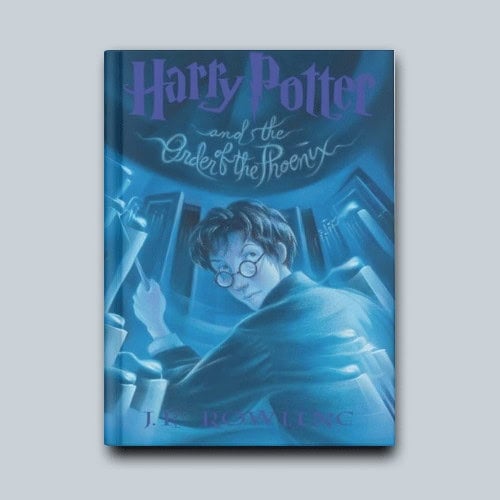
Harry Potter and the Order of the Phoenix — J.K. Rowling

At 870 pages, Harry Potter and the Order of the Phoenix is the longest book in J.K. Rowling’s series — and also its most divisive. Some fans consider it the best. Others find Harry’s sustained anger and the novel’s length difficult. Both positions are defensible. What’s not debatable: this is where the series stops being about wonder and starts being about the cost of fighting for what’s right.
Where We Are
Harry returns to Hogwarts after a traumatic summer — haunted by Cedric Diggory’s death and Voldemort’s return at the end of Goblet of Fire. Nobody believes him. The Ministry of Magic, led by Cornelius Fudge, has actively suppressed news of Voldemort’s return to avoid mass panic and protect the Minister’s political position.
The result is a year of mounting frustration: Harry is dismissed, ridiculed, and actively undermined by the Ministry’s appointed representative at Hogwarts, Dolores Umbridge.
The Key Players
Harry Potter at Fifteen
Harry is fifteen and furious — justifiably so. He has witnessed things no one should witness, adults who should know better keep dismissing him, and he is isolated even from his closest friends by the weight of what he knows. His frustration frequently tips into outbursts that alienate people around him.
This is a deliberately less likeable Harry, and Rowling commits to it fully. It’s also one of the most psychologically honest depictions of adolescent trauma in YA fiction.
Dolores Umbridge
Widely regarded as one of fiction’s great villains — not despite her pink cardigans and institutional authority, but because of them. Umbridge represents the banality of evil: bureaucratic cruelty dressed in politeness and procedure. She is the Ministry’s instrument in Hogwarts, and she makes the school a genuinely hostile environment.
Her methods — detention as literal torture, control of curriculum, suppression of truth — are not cartoon villainy. They’re recognisable.
Sirius Black
Harry’s godfather is the emotional heart of the book. His death in the Department of Mysteries — sudden, almost casual — is one of the most devastating moments in the series, and the loss reverberates through the remaining two books.
Luna Lovegood and Neville Longbottom
Both characters grow significantly here. Luna — in her eccentric, unshakeable sincerity — provides comfort no one else can. Neville’s arc, quietly moving throughout, culminates in real, earned courage at the Ministry. His backstory, revealed in this book, reframes everything we thought we knew about him.
Dumbledore’s Army
With Umbridge preventing any practical Defence Against the Dark Arts instruction, Harry forms a clandestine student group — Dumbledore’s Army — to teach real defensive magic to classmates. This storyline is the emotional and thematic counterweight to the Ministry’s denial: if the institutions won’t protect you, you build something yourself.
The DA scenes are among the warmest in the book — a respite from the oppressive year outside, and a demonstration that community and purpose are powerful antidotes to helplessness.
Themes That Hit Harder Over Time
Institutional Denial
The Ministry’s suppression of the truth about Voldemort is uncomfortably recognisable. A government choosing comfortable misinformation over difficult reality. The media — The Daily Prophet — acting as propaganda arm for the official line. The authorities attacking the credibility of anyone who challenges them.
Rowling wrote this in 2003. It has aged badly in the most useful way.
The Cost of Trauma
Harry’s PTSD is never named as such, but it’s precisely depicted. His isolation, anger, and inability to communicate what he has been through ring painfully true. The adults around him largely fail to meet him where he is — a failure the book implicitly criticises.
Media as Power
The Daily Prophet’s character assassination of Harry and Dumbledore mirrors real-world dynamics of media serving power rather than truth. The Quibbler — the alternative press — becomes a vehicle for telling the story the mainstream won’t touch. Luna’s father prints the truth.
The Department of Mysteries
The climax — a midnight infiltration of the Ministry’s Department of Mysteries — is chaotic, terrifying, and genuinely earned. The prophecy, the battle, Sirius’s death, and Voldemort’s moment of public revelation all collide in a sequence that leaves Harry (and the reader) shattered.
The prophecy itself — “Neither can live while the other survives” — reframes Harry’s entire life. He has not been living it on his own terms; he has been living a story written before he was old enough to choose.
Final Verdict
Order of the Phoenix is a long, difficult, essential read. It is not the most comforting Harry Potter book — it is the most politically and emotionally ambitious. It earns its length because what it’s doing is harder than adventure: it’s asking what it costs to tell the truth when institutions are actively working to suppress it, and what you owe to that effort when you’re fifteen years old and already exhausted.
Not everyone will love it. But it might be the one that matters most.