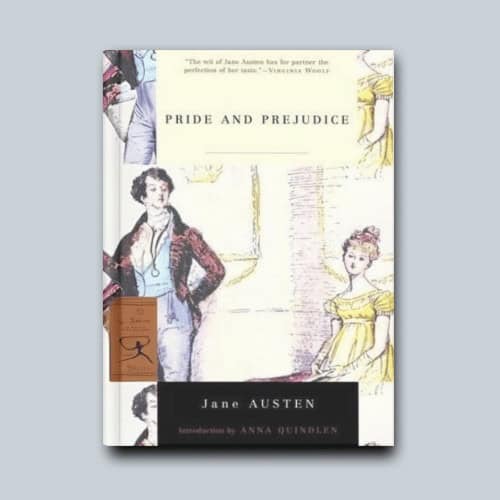
Pride and Prejudice — Jane Austen

Published in 1813, Pride and Prejudice remains one of the most widely read novels in the English language. Jane Austen’s story of Elizabeth Bennet and Fitzwilliam Darcy has survived over two centuries of changing tastes, spawned countless adaptations, and defined what a romantic hero and heroine can be. Here’s why it still works.
The Life and Times of Jane Austen
Jane Austen was born on December 16, 1775, in Steventon, Hampshire, to Reverend George Austen and Cassandra Austen. As the seventh of eight children in a lower gentry family, she grew up surrounded by literature and intellectual discussion despite lacking formal education. Her father’s extensive library and the family’s love of reading shaped her early development as a writer.
Writing during the Regency era, Austen witnessed significant social and economic shifts during the Napoleonic Wars. The period’s rigid social hierarchy, class distinctions, and severely limited opportunities for women directly influenced her thematic choices. Her novels critique these structures — often through comedy so sharp it still bites.
Publication History
Initially titled First Impressions, the novel was renamed and published anonymously in 1813. Austen’s authorship remained officially unconfirmed until after her death. Contemporary critics offered mixed reactions — some praised its wit and social insight while others questioned its portrayal of women and class dynamics.
Plot Overview
The Bennet Family
The narrative centres on the Bennet family — Mrs. Bennet, her husband, and their five daughters. Financial insecurity stems from an entailed estate passing to a cousin, Mr. Collins, creating urgency for the daughters to marry advantageously. When wealthy bachelor Mr. Bingley arrives in the neighbourhood and shows interest in Jane, the eldest daughter, the stage is set.
The Arrival of Mr. Darcy
Bingley’s immediate attraction to Jane contrasts with Darcy’s initial disapproval of Elizabeth. Their complicated dynamic — driven by Darcy’s pride and Elizabeth’s prejudice — forms the novel’s central tension. As misunderstandings accumulate, both characters are challenged to reassess their perceptions and grow as people.
Key Characters
Elizabeth Bennet: The Spirited Heroine
Elizabeth represents independence and wit in a world that offered women precious little of either. She is unafraid to challenge social conventions and refuses the first two marriage proposals she receives — including one from Darcy himself. Her character arc involves recognising her own misjudgements alongside Darcy’s genuine nature.
Fitzwilliam Darcy: Pride and Transformation
Initially presented as proud and dismissive, Darcy undergoes significant transformation as his genuine nature emerges. His famous first proposal — proud, insulting, and in its own way honest — is one of the most psychologically complex moments in the novel. His arc from arrogance to humility anchors the emotional core.
Supporting Characters
Mr. Wickham — charm masking dishonour, used to expose the dangers of first impressions.
Mr. Collins — obsequious, self-important, and satirically perfect. His relationship with Charlotte Lucas reflects economic realities rather than romantic feeling.
Mrs. Bennet — often played for pure comedy, but Austen understands that her anxiety is rational given the family’s circumstances.
| Character | Significance |
|---|---|
| Elizabeth Bennet | Protagonist; wit, independence, personal growth |
| Fitzwilliam Darcy | Transformation from pride to genuine love |
| Jane Bennet | Kindness and foil to Elizabeth’s sharpness |
| Mr. Wickham | Deceit and the danger of first impressions |
| Mr. Collins | Satire of social hierarchy and clerical pomposity |
Themes
Marriage as Economic Strategy
In this world, marriage is primarily economic necessity. The Bennet family’s entailed estate and five unmarried daughters exemplify the precarious circumstances women faced. Marriage represented survival and security — Austen never lets the reader forget this, even in the most romantic scenes.
Social Mobility and Class
Substantial fortunes determined eligibility and social standing. Darcy and Bingley occupy the highest social tier, while the Bennets occupy a more precarious position. The novel explores how class shapes behaviour, perception, and possibility.
The Evolution of Pride and Prejudice
Darcy’s pride initially alienates Elizabeth and colours his social interactions. Elizabeth’s prejudice against Darcy, rooted in misunderstanding and Wickham’s manipulations, gradually transforms into clear-eyed appreciation. Both must earn the reader’s (and each other’s) trust through change.
Austen’s Writing Style
Irony and Wit
Austen employs irony and humour to critique social absurdities. The famous opening line — “It is a truth universally acknowledged, that a single man in possession of a good fortune, must be in want of a wife” — is simultaneously a statement of social fact and a dry satire of the assumptions driving the entire novel.
Free Indirect Discourse
This narrative technique grants readers direct access to characters’ thoughts and emotions, creating intimacy while revealing motivations that the characters themselves sometimes don’t fully understand. It was genuinely innovative in its time and remains technically impressive.
Social Commentary Through Dialogue
Conversations between characters illuminate era-specific norms and expectations. Elizabeth’s exchanges with Lady Catherine de Bourgh — who expects deference and gets defiance — are among the most pleasurable in English literature.
Cultural Impact and Adaptations
The novel has inspired numerous film and television interpretations:
- The 1995 BBC mini-series (Colin Firth, Jennifer Ehle) — widely considered the definitive adaptation
- The 2005 film (Keira Knightley, Matthew Macfadyen) — notable for its cinematic visuals and emotional directness
- Death Comes to Pemberley by P.D. James — sequel
- Pride and Prejudice and Zombies by Seth Grahame-Smith — genre-blending parody
These adaptations have broadened the novel’s audience and cemented its place in British heritage culture.
Relevance Today
The novel’s exploration of societal pressure, family expectations, and personal identity resonates with modern audiences. Concerns about social status and economic security echo the Bennet family’s struggles — updated contexts, same pressures. Elizabeth and Darcy’s character development provides meaningful insights into what it takes to really know another person.
Conclusion
Pride and Prejudice endures because Austen is genuinely funny, her characters are genuinely complex, and the central relationship — two intelligent people who misjudge each other and must work to see clearly — remains endlessly satisfying. The social world she depicts is gone but her understanding of human nature is not. That’s why it’s still being read two centuries later.