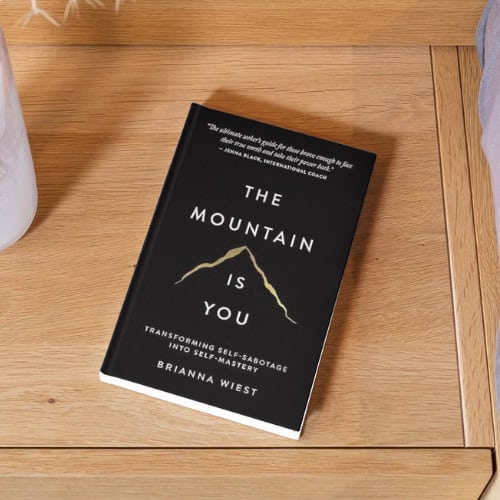
The Mountain Is You — Brianna Wiest

The mountain in the title isn’t out there — it’s you. Brianna Wiest’s The Mountain Is You is a book about self-sabotage: why we do it, what it’s actually protecting us from, and how to stop undermining our own lives. It’s one of the most emotionally honest self-help books in recent years, and it resonates because most of us recognise ourselves in it.
Who Is Brianna Wiest?
Brianna Wiest is a widely read author in the self-help field. Her books, including The Mountain Is You, have had significant impact on readers working to overcome self-limiting behaviours. Her writing is accessible without being shallow — she makes tough psychological ideas understandable and applicable.
The Core Premise
The book is about understanding and moving past self-sabotaging behaviour. It teaches readers to change the subconscious patterns that stop them from growing — and it promises to lead them through a process of self-discovery toward genuine self-mastery.
The central insight: self-sabotage isn’t random or irrational. It serves a purpose. Understanding that purpose is the key to changing it.
Understanding Self-Sabotage
What Self-Sabotage Actually Is
Wiest explains self-sabotage as actions that undermine our success and happiness, often driven by unconscious fears or unresolved emotional issues. The behaviours that look like weakness are often functioning as protection — from failure, yes, but also from success and the changes it brings.
The Hidden Benefits of Self-Destructive Behaviours
Self-sabotage can act as a coping mechanism. It offers a temporary escape or comfort from the fear of change. People often stick to self-destructive behaviours because they’re familiar — the comfort of known patterns, even harmful ones, can feel safer than uncertainty.
Understanding these dynamics is the first step toward changing them.
The Mountain Metaphor
The mountain represents the inner obstacles we create for ourselves — the walls that stop us from being our best. Wiest’s crucial reframe: the mountain isn’t the enemy, it’s the path. Climbing it — with all its hurdles — is where growth actually happens.
This view aligns with contemporary personal growth literature: development is about the process, not just reaching the destination. The climb matters more than the summit.
Key Insights on Emotional Intelligence and Healing
Emotional Healing as a Foundation
Emotional healing means facing and dealing with emotions rather than hiding them. Healing involves learning to navigate difficult feelings rather than avoiding them — a critical step toward lasting transformation.
Transforming Emotional Responses into Conscious Choices
Turning emotional responses into thoughtful choices is central to emotional intelligence. This means understanding the difference between reacting and responding to emotions. By choosing to respond rather than react, we can escape bad patterns and live more intentionally.
Breaking Destructive Patterns
Identifying Your Triggers
Spotting the triggers and patterns of self-sabotage requires attention to thoughts, feelings, and actions over time. Journalling and mindfulness practices help reveal these patterns — which is why Wiest includes both throughout the book.
Actionable Techniques for Pattern Interruption
- Cognitive restructuring — switching negative thought patterns to more accurate ones
- Emotional regulation — developing the capacity to manage emotions rather than be managed by them
- Daily mindfulness practices — increasing awareness of self-sabotaging behaviour before it becomes action
Creating New Neural Pathways
By repeating new behaviours and thoughts, we create new neural pathways — neuroplasticity applied to personal growth. This is why consistency matters more than intensity.
| Technique | Description | Benefit |
|---|---|---|
| Cognitive Restructuring | Changing negative thought patterns | More realistic, positive outlook |
| Emotional Regulation | Managing emotions deliberately | Better decision-making |
| Mindfulness | Increasing self-awareness | Reduced automatic self-sabotage |
The Psychology of Resistance
Why We Unconsciously Resist Personal Growth
We resist growth because of fear, past hurts, or the discomfort of change. Wiest notes that recognising resistance is often a sign of readiness for significant transformation — the resistance indicates there’s something real at stake.
Common sources of resistance:
- Fear of losing who we are or our sense of self
- Past experiences that taught us change leads to loss
- The comfort zone’s familiarity, even when it’s limiting
Embracing Discomfort as a Catalyst
Embracing discomfort is vital for growth. Facing and overcoming fears leads to meaningful personal development. This doesn’t mean seeking suffering — it means not automatically retreating from difficulty.
Mindset Shifts That Transform
From Fixed to Growth Mindset
Wiest encourages seeing challenges as opportunities to grow rather than threats to the ego. With a growth mindset, failures become chances to learn rather than evidence of inadequacy.
Reframing Challenges as Resilience-Building
Instead of seeing problems as obstacles, we can see them as the mechanism by which we develop genuine resilience — the kind that isn’t fragile because it was tested.
| Mindset | Characteristics | Outcome |
|---|---|---|
| Fixed Mindset | Avoids challenges, sees failure as a threat | Stagnation, fear of failure |
| Growth Mindset | Embraces challenges, sees failure as learning | Personal growth, resilience |
Strengths and Limitations
What the Book Does Brilliantly
The book stands out by offering a thorough examination of self-sabotage. Wiest’s writing is engaging, making tough topics easy to grasp. It demonstrates powerfully how emotional healing is key to growth, and how changing our emotional responses can lead to significant life changes.
Where It Could Go Deeper
Some readers may find certain strategies somewhat foundational. Adding more detailed case studies could strengthen sections that feel more general.
| Strengths | Limitations |
|---|---|
| Comprehensive understanding of self-sabotage | Some sections feel generic |
| Engaging, accessible writing style | Could benefit from more case studies |
| Actionable techniques for personal growth | Certain strategies may feel familiar |
Conclusion
The Mountain Is You is a valuable guide for anyone willing to ask uncomfortable questions about their own role in their circumstances. It’s both deep and practical — and its central insight, that our biggest obstacle is usually ourselves, is worth sitting with regardless of whether you’ve read a hundred self-help books or none.
If you’re searching for a self-help book that honestly addresses why we get in our own way — and what to actually do about it — Brianna Wiest’s work merits a place on your shelf.