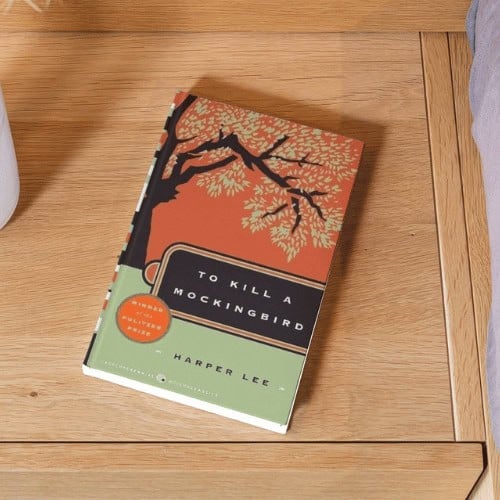
To Kill a Mockingbird — Harper Lee

Published in 1960, To Kill a Mockingbird won the Pulitzer Prize in 1961 and has never stopped being read. Harper Lee’s novel — set in the Deep South during the 1930s, told through the eyes of a child — confronts racial injustice, moral courage, and the painful loss of innocence with a clarity that still feels urgent.
The Life of Harper Lee
Nelle Harper Lee was born on April 28, 1926, in Monroeville, Alabama — a setting that would deeply influence her writing. Growing up in a small town with a lawyer father, she was exposed to the justice system and racial tensions that would become central to her work. Her close childhood friendship with Truman Capote also shaped her literary development.
After moving to New York, Lee worked on her writing while holding other jobs. Her experiences and observations of racial injustice significantly influenced To Kill a Mockingbird — including specific incidents from her childhood that mirror events in the novel.
Historical Context
The novel is set during the Great Depression in the fictional Maycomb, Alabama. The economic hardship faced by families like the Cunninghams and Ewells reflects real conditions of the era, while the racial segregation and systemic injustice are drawn from documented historical reality.
The Great Depression had stripped communities of economic stability while doing nothing to loosen the racial hierarchy. Black citizens in the American South faced institutional prejudice at every level — courts, police, workplaces, churches — and To Kill a Mockingbird confronts this directly through the trial of Tom Robinson.
Plot Overview
The Finch Family
The story is narrated by Scout Finch, a young girl whose father, Atticus Finch, is a lawyer in Maycomb. Scout’s brother Jem and their summer friend Dill form the children’s triangle through which the novel’s adult world is filtered.
The Tom Robinson Trial
The novel’s central conflict: Atticus is assigned to defend Tom Robinson, a Black man falsely accused of raping a white woman. He takes the case seriously, building a compelling defense — and knowing he will almost certainly lose. The jury’s verdict illustrates the deep-seated racial injustice pervading the legal system.
The Boo Radley Storyline
Running alongside the trial is the children’s obsession with Boo Radley, the reclusive neighbour who has become a figure of local legend and fear. This storyline — in which the children gradually understand that Boo is not monstrous but kind — provides the emotional counterpoint to the harsher trial narrative.
Major Characters
Scout Finch: The Narrator
Scout’s innocence and curiosity drive the narrative, providing insight into the events of Maycomb through a child’s eyes. Through Scout, Lee explores childhood innocence and the gradual, painful loss of that innocence as she faces her community’s realities.
Atticus Finch: Moral Compass
Atticus is the novel’s moral backbone — not a perfect man, but one who teaches his children to consider things from others’ viewpoints and to do what’s right regardless of social cost. His defense of Tom Robinson is a pivotal act: he knows the outcome is likely predetermined, and he does it anyway.
Jem Finch: Coming of Age
Scout’s older brother undergoes significant development, grappling with the injustices he witnesses. His transition from childhood to adolescence is marked by a growing awareness that the adults around him are capable of deliberate cruelty — a loss of innocence that’s different from Scout’s and arguably more painful.
| Character | Role | Thematic Significance |
|---|---|---|
| Scout Finch | Narrator and protagonist | Childhood innocence and moral growth |
| Atticus Finch | Moral compass and father | Justice, empathy, and integrity |
| Jem Finch | Coming of age | Awareness of societal injustice |
| Tom Robinson | Wrongly accused man | Racial prejudice and institutional failure |
| Boo Radley | Recluse, ultimately protector | Perception vs. reality, empathy |
Themes
Legal Justice vs. Moral Justice
The novel highlights the stark contrast between legal outcomes and moral truth. Despite overwhelming evidence of Tom Robinson’s innocence, he is found guilty. This is not presented as surprising — it’s presented as the system working exactly as designed. The moral lesson falls on the children watching, not the jury delivering the verdict.
The Mockingbird Symbolism
The “mockingbird” represents innocence and kindness — characters who harm no one and are harmed by others. Tom Robinson and Boo Radley are the novel’s primary mockingbirds. Atticus explains early: “It’s a sin to kill a mockingbird.” Both men are destroyed or diminished by a community that cannot accommodate them.
Racial Inequality and Prejudice
Maycomb’s racism is institutional and social — embedded in the court system, social hierarchy, and daily interactions. The novel doesn’t soft-pedal this. Tom Robinson’s conviction in the face of clear evidence isn’t a failure of the system; it’s the system functioning as its community designed it.
Literary Techniques
First-Person Narration from Childhood
The novel’s power comes partly from its narrative distance. Scout’s child’s-eye view captures the absurdity and cruelty of adult behaviour with devastating effect. What adults normalise, a child sees plainly.
Language, Humour, and Southern Dialect
Lee’s use of language and humour adds warmth to an often-dark narrative. Southern dialect and the rhythms of small-town life give the story authenticity while the comedy — often at the expense of Maycomb’s social pretensions — prevents the novel from becoming polemic.
Film Adaptation and Cultural Impact
The 1962 film, directed by Robert Mulligan, starred Gregory Peck as Atticus Finch. Peck’s performance earned him an Academy Award for Best Actor and remains definitive. The character of Atticus Finch became a cultural symbol of legal integrity, influencing generations of lawyers and readers.
Educational Impact and Continued Relevance
The novel is widely taught in schools for its exploration of justice, empathy, and civil rights. Its themes of racial inequality, police brutality, and systemic injustice remain as relevant to contemporary discussions as they were at publication.
It has also faced censorship attempts — primarily over racial language — a tension that reflects the novel’s subject matter: what communities choose to see, and what they prefer to look away from.
Conclusion
To Kill a Mockingbird is a novel that asks children to notice what adults have taught themselves not to see. It does so with warmth, humour, and an unsentimental clarity about human nature. More than six decades after publication, it remains a useful, uncomfortable, and necessary book.