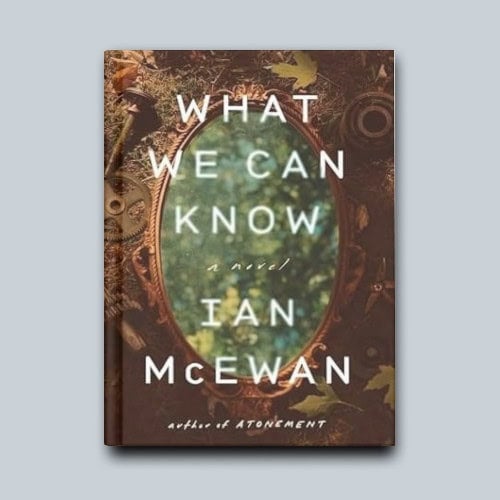
What We Can Know — Ian McEwan

Ian McEwan has spent his career as a novelist asking difficult questions about human nature and the world we’ve made. What We Can Know turns that instinct towards epistemology — the philosophy of knowledge itself. What do we actually know? What do we merely believe? And what is the cost of confusing the two?
The Literary Journey of “What We Can Know”
The genesis of What We Can Know is rooted in McEwan’s long-standing fascination with the intersection of science, philosophy, and literature. He has engaged with the scientific and philosophical communities throughout his career — reflected in novels like Solar and Machines Like Me — and this work represents a more direct reckoning with the ideas that have always animated his fiction.
Initial critical response praised the book’s thematic depth and McEwan’s accessible treatment of difficult ideas, while also noting the challenge of material that resists easy resolution.
McEwan’s Intellectual Foundations
McEwan’s worldview has been shaped by a variety of intellectual influences: the scientific community, philosophical thought, and the literary figures who’ve engaged seriously with questions of knowledge and reality. His work reflects consistent engagement with rationalism and empiricism — the idea that knowledge comes from evidence and reason, not authority or tradition.
Key intellectual influences include the scientific method as a model for understanding human behaviour, philosophical debates around the nature of knowledge and reality, and the work of scientists like Richard Dawkins and Steven Pinker.
The Central Thesis
The Epistemological Framework
McEwan constructs an epistemological framework that is both nuanced and accessible. He draws on philosophy, cognitive science, and history to examine how we acquire knowledge — through perception, cognition, and reasoning — and what limitations affect each.
The framework has practical implications. Our understanding of the world is always filtered through cognitive biases and perceptual limitations. Recognising this doesn’t mean abandoning knowledge; it means holding it more honestly.
Knowledge vs. Certainty
McEwan makes a critical distinction between knowledge and certainty. We can possess knowledge while remaining uncertain about its completeness or reliability. This perspective challenges the desire for absolute certainty — instead advocating for a more provisional, revisable understanding of what we know.
This matters beyond philosophy. In domains from medicine to climate science to everyday decision-making, the confusion between knowledge and certainty has consequences. The willingness to say “this is what the evidence currently shows, and I could be wrong” is, McEwan argues, a form of intellectual courage.
The Limits of Human Understanding
Cognitive Biases and Perceptual Limitations
One of the primary constraints on human understanding is the presence of cognitive biases — systematic errors in thinking that distort our perception of reality. These biases operate largely below conscious awareness, affecting judgement and decision-making in ways we rarely notice without deliberate effort.
Perceptual limitations further restrict our understanding. Our senses can be deceived, our memories distorted, our reasoning manipulated by the framing of information. McEwan highlights the importance of recognising these constraints as the starting point for more accurate understanding.
The Humility of Not Knowing
McEwan’s work emphasises the value of intellectual humility. Acknowledging the limits of our knowledge is not weakness — it’s the foundation of genuine inquiry. The alternative — the false certainty of those who refuse to revise their beliefs in light of evidence — leads to the epistemological crises the book directly addresses.
The beauty in mystery, as McEwan frames it, lies not in the answers we have but in the questions we’re willing to ask — and sit with.
Science and Rationality
Scientific thinking plays a pivotal role in McEwan’s argument. He emphasises evidence-based reasoning and the scientific method as models for how knowledge should be acquired and held: systematically, provisionally, with willingness to revise.
He is also known for challenging pseudoscientific and magical thinking — the substitution of comfortable certainty for accurate uncertainty. This isn’t polemic but a consistent philosophical position running through his work.
Moral and Ethical Dimensions
Knowledge as Ethical Responsibility
McEwan posits that knowledge is not merely a possession but an ethical responsibility. Having knowledge implies a duty to use it wisely. This connects epistemology to ethics — what we know about climate change, about inequality, about human psychology — carries obligations for action.
The Moral Implications of Ignorance and Denial
Willful ignorance and denial have consequences that go beyond the individual. McEwan explores how these states affect not just personal decisions but social and political outcomes. The refusal to update beliefs in response to evidence is not neutral — it causes harm.
Cultural Relevance
What We Can Know is deeply timely. Post-truth politics, information overload, and the proliferation of misinformation have created an epistemological crisis — in public life, people increasingly choose comfortable belief over difficult evidence. McEwan’s framework offers tools for navigating this.
The book addresses:
- The erosion of trust in institutions and expertise
- The role of misinformation in fragmenting shared reality
- The challenge of discernment when information is abundant and unreliable
- The responsibility of individuals and institutions to accurate knowledge
McEwan’s Writing Style
His prose is clear and accessible without being simplistic. He avoids overly technical language, making the philosophical material approachable for a broad audience without sacrificing precision. His tone is reflective and inquiring — inviting the reader to think alongside him rather than simply absorbing conclusions.
Conclusion
What We Can Know is a work that challenges readers to confront their own cognitive biases and perceptual limitations. In engaging with these ideas, readers develop a deeper understanding of intellectual humility — the recognition that knowledge is provisional and that the willingness to revise is a strength, not a weakness.
In an era of comfortable certainty and aggressive misinformation, McEwan’s exploration of what we actually know — and how tentatively we should hold it — is more valuable than ever. It is the kind of book that changes how you think, which is the best thing any book can do.